

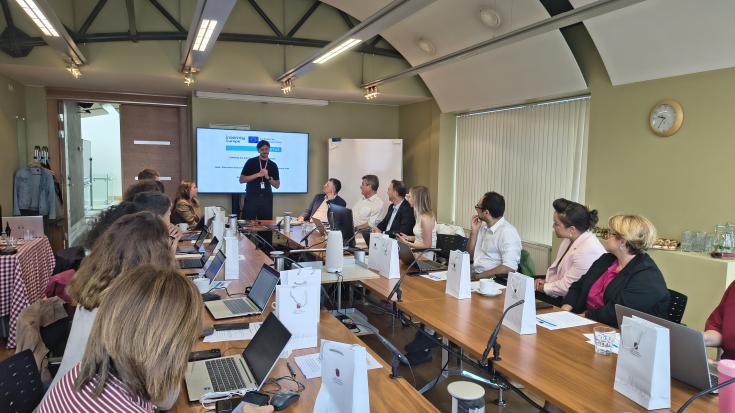
During Semester 5, the IMPETUS project launched its fourth thematic loop, focusing on alternative financing models and mechanisms for temporary use of urban spaces.
The objective was to explore how financial and fiscal instruments can unlock the potential of underused areas, turning vacancy into opportunity. Good practices were analysed, showing how temporary use can be sustained and scaled when supported by appropriate tools – from property tax reductions and targeted subsidies to hybrid revenue models blending public funds with entrepreneurial activity. Cities and regions across Europe are testing new approaches to foster inclusive, creative, and adaptive urban transformation.
Temporary use has emerged as a powerful strategic lever, bringing immediate value while shaping long-term change. Supported by coherent policy frameworks, collaborative governance, and flexible financing tools, temporary use becomes a driver of regeneration, participation, and resilience.
April 2025 – Shared Learning in Lille
In April 2025, the fourth Interregional Thematic Seminar (ITS) took place in Lille, hosted by the Métropole Européenne de Lille. Partners presented good practices from Tuscany, Riga, Sochaczew, Bucharest and Las Palmas de Gran Canaria, alongside inspiring examples from Mazovia and the Paris-based cooperative Plateau Urbain. Participants also visited local initiatives such as Terrain Rouge in Roubaix and Les Manufactures Tissel, a former industrial site transformed into a hub for circular economy projects.
July 2025 – Policy Brokerage in Riga
On 8–9 July 2025, the fourth Interregional Policy Brokerage (IPB) was held in Riga, marking a new phase in thematic exchange. The meeting was welcomed by Riga’s City Development Department and Mayor Viesturs Kleinbergs. A central activity was the “Policy Clinic”, a hands-on workshop addressing challenges related to funding transitional uses, incentivising activation, and managing tax exemptions. Participants also visited spaces managed by Free Riga – the KM12 creative centre and the Veldze site in transformation – as well as the historic Riga Central Market, where future development plans aim to balance heritage and contemporary needs.
New IMPETUS Handbook
In June, the third IMPETUS Handbook was published, dedicated to the role of urban agencies as enablers of sustainable regeneration through temporary use. This edition highlights inspiring practices from Semester 4, with a special focus on how intermediaries can support citizen-led transformation of underused spaces.

